After the rains: how to stop mosquitoes breeding in your home
The mosquito that spreads dengue lays its eggs in clean water standing in and around the home. Empty, scrub and cover every water container once a week, and protect children from bites during the day.
The monsoon is over, but mosquitoes do not leave with the rain. Water that collects in pots, coolers, old tyres and flower pot trays can keep mosquitoes breeding for weeks. The mosquito that spreads dengue and chikungunya, called Aedes, likes to breed in exactly these places, close to where families live.
The good news is that each family can do a lot to stop this, with a few minutes of work every week. Diwali cleaning is a very good time to start.
Know the mosquito
The Aedes mosquito is different from the one that bites at night. It bites during the daytime, mostly in the early morning and in the late afternoon before sunset. It lives and rests indoors, in dark corners, behind curtains and under furniture.
It lays its eggs in clean, still water held in containers. Indian government guidance notes that an egg can become an adult mosquito in about 7 to 8 days. This is why checking for standing water once every week breaks the cycle before new mosquitoes are born.
The eggs stick to the inside walls of containers and can survive drying for months. When water fills the container again, they hatch. So emptying is not enough: the inside of the container also needs a good scrub.
Where mosquitoes breed at home
Walk around your home, terrace and courtyard once a week and look for any place where water stands:
- Water drums, buckets, tanks and earthen pots used for storing water.
- Desert coolers, especially ones left with water after the summer.
- Flower vases, money plant bottles and the trays under flower pots.
- Old tyres, broken pots, coconut shells, plastic cups and bottles lying outside.
- Bird and animal water bowls.
- The tray under the fridge, and any blocked drains or gutters on the roof.
What you can do
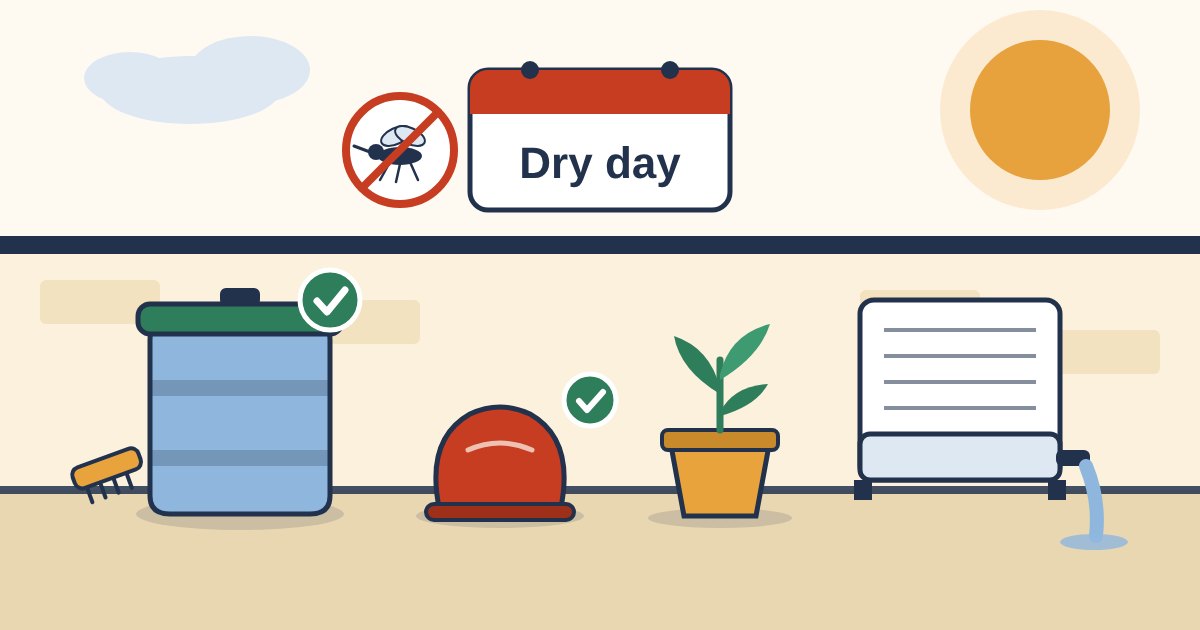
- Choose one dry day every week. On that day, empty all containers that are not needed, scrub the inside walls and let them dry before you refill.
- Cover water you store. Keep a tight lid on every drum, tank and pot. A cloth tied firmly over the mouth also helps.
- Clean the cooler. Empty, scrub and dry it every week, or empty it completely if you are not using it now.
- Change water in vases and plant bottles every week, and remove the trays under flower pots or empty them.
- Throw away junk that holds water, such as old tyres, broken pots and plastic cups, or turn it upside down.
- Fit wire mesh on windows and doors where you can, and keep it in good repair.
Protect children from bites
Because this mosquito bites in the day, think about school hours, play time and the afternoon nap:
- Dress children in light clothes that cover the arms and legs.
- Let babies and young children nap under a mosquito net, even during the day.
- Cover a baby's pram or carrier with mosquito netting.
- If you use a mosquito repellent on the skin, follow the instructions on the pack. An adult should put it on the child. Keep it away from the eyes, mouth, hands and any cuts.
- Do not use skin repellent on babies younger than 2 months. Use clothing and nets instead.
When to see a doctor
There is no special medicine that kills the dengue virus, which is why prevention matters so much. If your child has a fever, take them to a doctor rather than giving medicines on your own. See a doctor urgently if a child with fever has severe tummy pain, keeps vomiting, breathes fast, bleeds from the gums or nose, has blood in the vomit, or becomes very tired, restless or drowsy. These signs can appear even as the fever is going down.
Mosquito control works much better when the whole street joins in. Talk to your neighbours, and let your local ASHA worker or municipal health team know about open tanks or water collecting in public places.
References
- National Center for Vector Borne Diseases Control, Ministry of Health and Family Welfare, Government of India. Handbook on Prevention and Control of Dengue in School. New Delhi: NCVBDC; 2019. Link
- World Health Organization, Regional Office for the Eastern Mediterranean. Dengue and severe dengue (fact sheet, World Health Day 2014). Cairo: WHO EMRO; 2014. Link
- Centers for Disease Control and Prevention. Mosquito Bite Prevention: How to Protect Against Mosquito Bites. Atlanta: CDC; 2024. Link
This note is health education for the public. It does not replace a consultation with a doctor who can examine your child.
Prepared with AI assistance; medically reviewed by Dr Harshal Khade before publishing. Illustration created with AI assistance.